Showing posts with label Technologies. Show all posts
Thursday, 1 December 2011
Saturday, 26 November 2011
Kyobo eReader's XGA Mirasol Display Could Challenge LCDs
![]() |
Kyobo eReader's XGA Mirasol Display Could Challenge LCDs |
The "Kyobo eReader" was unveiled this week in Seoul and will reach South Korean consumers as early as Dec. 1, Kyobo Book Centre officials said Thursday.
The e-reader features Qualcomm's 1.0 GHz "Snapdragon" processor, a custom Kyobo application based on Android and a 5.7 inch "XGA" mirasol display.
The mirasol display uses ambient light instead of its own in much the same way that a peacock's plumage gets its scintillating hues. Qualcomm's mirasols have already been used in a few Chinese and South Korean phones, and in an MP3 player on the U.S. market. The display contains tiny mirrors that consume power only when they're moving, easing battery drain. Mirasol displays also quickly change from one image to the next and show video.
The global market for e-readers is dominated by bright LCDs and grayscale "e-ink" screens. LCDs consume relatively more battery power while e-ink screens are slow to refresh.
The introduction of the e-reader jointly developed by Qualcomm and Kyobo signals increasing competition in the global market for tablets.
U.S. online retailer Amazon.com Inc. and bookseller Barnes & Noble Inc. have recently released tablets of their own, Kindle Fire and Nook Tablet, and are challenging Apple's iPad in pricing.
Qualcomm CEO Paul Jacobs noted South Koreans' near-100 percent literacy rate and digital reading skills during a launching ceremony in Seoul on Tuesday, according to the San Diego-based company. Fifteen-year-old South Koreans scored highest in their ability to absorb information from digital devices, according to a 2009 study by the Organization for Economic Cooperation and Development. Over 80 percent of households in South Korea have broadband Internet access.
The e-reader featuring the mirasol display will be priced at 349,000 won, or $302, said Seoul-based Kyobo, South Korea's largest bookseller.
Thursday, 10 November 2011
Verizon Plans a Fast Lane for Some Apps
![]() | |
Breaking up: Verizon's new technology might allow customers to pay for high bandwidth in advance: if they wanted to avoid the picture breaking up while streaming a movie, for example. |
Wireless provider Verizon has developed technology that would allow mobile apps to request extra bandwidth for short periods—to fix a choppy video call if a local cell tower is experiencing high demand, for example, or to ensure that a video plays smoothly.
The feature is intended to allow bandwidth-hungry apps to survive even as soaring wireless Internet traffic from smart phones and tablets strains the networks serving them. However, users or the companies that make data-hogging apps will have to pay for such turbo boosts, and the feature could face opposition from advocates of "net neutrality," the philosophy that all Internet traffic should be treated equally.
Verizon demonstrated the new feature—which is still in development—at the company's Application Innovation Center in San Francisco last week. High-quality video streaming over a 4G cellular link became pixilated as the available bandwidth was throttled, to simulate what can happen when a lot of users request data in the same area. That was reversed when the application receiving the video used a new API to request a bandwidth boost.
"Maybe, for the first time in the world, programs can make the network coincide with their business and technology goals," says Hugh Fletcher, who leads Verizon's efforts to allow outside software to access data and features of the company's cellular network that are traditionally meant for internal use only.
Verizon plans to charge for the service. Fletcher says a consumer might pay directly for extra bandwidth for a short time: for example, to guarantee that a movie will stream at high quality. Alternatively, the cost of the extra bandwidth might be included in the price of a subscription to a movie streaming service, or added to the cost of a video call, for example.
Fletcher stressed that no business model or even preferred use cases have yet been settled upon for the bandwidth-boosting feature. However, he predicts that—as happened after the launch of Apple's mobile app store—mobile developers will create uses for the new feature that could never be imagined by those offering it. "Think of Verizon's network as a platform like Facebook or Twitter that developers can tap into the capabilities of," he says.
Thursday, 3 November 2011
Wonderful Bicycle Styles By Carlos Rolon
Technology |Wonderful Bicycle Styles By Carlos Rolon| Carlos Rolon is generally known as Dzine, he came to be in Chicago in 1970, he’s master in creating sculptures of various kinds that should be so attractive and mind-blowing and many of them are extremely little so peoples just thing how its made, lolllzzz, He’s also artist of installations, his illustration is completely awesome, eye catching. However today we just presented here beautiful his mad sculptures of bikes. Lately he’s created something really unusual. It’s a number of custom bikes encrusted with gold, platinum and crystals with all the author’s engravings and drawings
Tuesday, 1 November 2011
A Versatile Touch Sensor
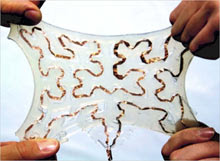
A new system adapted from a technology used for underwater cables could lead to touch sensors in clothes and coffee tables.
![]() |
| A Versatile Touch Sensor |
Technology | Technologies | We live in an increasingly touchy-feely tech world, with various ways for smart phones and tablet computers to sense our finger taps and gestures. Now a much cheaper type of touch technology, developed by researchers at the University of Munich and the Hasso Plattner Institute, could lead to touch sensitivity being added to everyday items such as clothing, headphone wires, coffee tables, and even pieces of paper.
The new touch technology relies on something called time domain reflectometry, or TDR, which has been used for decades to find damage in underwater cables. TDR is simple in theory: send a short electrical pulse down a cable and wait until a reflection of the pulse comes back. Based on the known speed of the pulse and the time it takes to come back, software can determine the position of the problem—damage in the line or some sort of change in electrical conductance.
Patrick Baudisch, professor of computer science at the Hasso Plattner Institute, says engineers noticed in the 1960s that the technology could be used to indicate a touch of a wire. Recently, the ability to sense the short time delay over very short distances has gotten more accurate, which made it possible to use TDR for interactive applications.
The TDR implementation is straightforward, according to Raphael Wimmer, a student at the University of Munich who developed the new approach with Baudisch. For one demonstration, he taped two parallel strips of copper to a piece of paper. Metal clips connect the copper strips to a pulse generator and detector. Pico-second-long electrical pulses are sent out, and if there's any change in capacitance between the two strips of copper—produced by a finger close to or touching the wires, for instance—part of the pulse is reflected back.
An oscilloscope shows the changing waveform produced by the reflected pulse, and software on a connected computer determines the position of the touch. The current setup is a bit clunky, Wimmer admits, but he says it should be feasible to shrink the pulse generation, detection, and position calculation onto a chip.
To make a surface touch-sensitive requires only two wires (or metal traces of conductive ink), which can be configured in various patterns to get the necessary coverage. In contrast, a capacitive touch screen like the one in the iPhone uses a matrix of wires coming out of two sides of the screen. "You have to route them to a controller in special ways, and that's quite complicated," says Wimmer. TDR avoids the engineering challenges of a traditional capacitive touch surface, he says.
"Wimmer's application of TDR to touch is very clever," says Jeff Han, founder and CEO of Perceptive Pixel, a company that is developing large multi-touch displays. He suspects that it could provide new ways of detecting user input like touch sensing along an unmodified headphone cable, something that would be difficult to do with traditional sensors.
Over the next couple of months, Wimmer says, the researchers will be testing ways to shrink the TDR system design into a chip. He says he's also exploring the possibility of using light pulses in fiber optics as well as electrical pulses in cables because light would be immune to the electrical interference common in capacitive touch systems.
Monday, 31 October 2011
Version of software is installed on your Apple iPhone, iPad, or iPod
![]() |
| iPhone 5 |
Technology|Version of software is installed on your Apple iPhone, iPad, or iPod|You can determine which version of software is installed on your iPhone, iPad, or iPod by navigating to the About screen:
iPhone, iPad, and iPod touch
- From the the Home Screen, tap Settings > General > About.
- The software version of your device will be listed on this screen.
Sunday, 30 October 2011
Microsoft and Nokia Deal
Technology|Microsoft and Nokia Deal|Microsoft is moving forward with a controversial deal that has the tech giant paying Nokia better than $1 billion in return for the handset maker to produce a wide array of Windows-based smartphones.
According to Bloomberg News, reports of Microsoft’s $1 billion “payoff” come from anonymous sources that are said to be close to the deal.
Wednesday, 26 October 2011
Researchers Couple Printed Logic with Printed Memory
![]() |
| Print out: The printed transistors on this sheet, made by PARC and Thinfilm, can address an array of printed memory cells. Thinfilm |
The device processes only small amounts of data, but at a very low cost.
Printed electronics have been advancing in bits and pieces for years—a crude processor here, a basic memory device there.
Now researchers at the Palo Alto Research Center (PARC) and the Norwegian companyThinfilm Electronics have announced a printed electronic device that, for the first time, marries transistors with memory. The device provides a low-cost way to read, write, and process small amounts of data. In addition, the added logic increases the amount of data that can be stored.
Printed circuits, made of organic inks, operate far more slowly and with less memory capacity than their silicon counterparts, but they can be made for pennies. Printed circuits can also go where silicon currently cannot: wrapping around a child's toy, for example, or conforming to the curve of a soldier's helmet.
Earlier this year, Thinfilm showed off a handheld device capable of reading cards printed with circuits that store 20 bits of data. In May, the company announced engineering deals with two major toy manufacturers who plan to use its printable memory.
Adding logic to memory is crucial to increasing the storage capacity of the device, explains Janos Veres, manager of printed electronics at PARC. "We really needed to have a printed logic array that lets us address memory and increase bit count," he says. Memory arrays are split up into rows and columns. To select a row or column, you need a logic circuit, Veres says. "The power of this demonstration is we've shown that you can address rows and columns with this technology," he says. "The next step will be building bigger memory."
One of the major advances of this prototype is the development of printed logic circuits that are analogous to so-called CMOS circuits in silicon. CMOS stands for complementary-metal oxide-semiconductor—a combination of two key kinds of transistors, called an n-type and a p-type.
Tuesday, 25 October 2011
New Technique Turns Viruses Into Useful Tools
![]() |
| Viral films: Complex, highly structured films made using viruses could be used as optical devices and as templates for engineering tissue, bone, and teeth. Woo-Jae Chung, UC Berkeley |
The researchers, led by Seung-Wuk Lee, a bioengineering professor at the University of California, Berkeley, used the technique to make structured films. "We want to mimic nature and create many different types of functional structures with a very simple building block," Lee says.
This work is part of a broader effort to make new types of materials using viruses as microscopic building blocks. Researchers at MIT, led by Angela Belcher, a biological engineering and materials science professor, have previously engineered viruses to bind toinorganic materials—something they would never do naturally—and have them assemble intobattery components.
Lee and his colleagues have found a way to fine-tune the arrangement of individual viruses to create sophisticated structures with complex designs all on their own. Using a single virus as a building unit is "pretty exquisite," says Belcher, because its traits can be genetically modified and you can attach many different useful materials to its surface. What's even more important about the new work, which was published in the journal Nature last week, is the precise control over viral self-assembly, resulting in large-scale structures with multiple levels of organization. "This is very beautifully laid out," she says. "They can do so much with a single virus.
Researchers have demonstrated a simple, one-step process in which genetically engineered viruses arrange themselves into extremely ordered patterns with distinctive properties, such as color or strength. The technique could be used to make novel optical devices or biological scaffolds to grow soft tissue, teeth, and bone.
The researchers, led by Seung-Wuk Lee, a bioengineering professor at the University of California, Berkeley, used the technique to make structured films. "We want to mimic nature and create many different types of functional structures with a very simple building block," Lee says.
This work is part of a broader effort to make new types of materials using viruses as microscopic building blocks. Researchers at MIT, led by Angela Belcher, a biological engineering and materials science professor, have previously engineered viruses to bind toinorganic materials—something they would never do naturally—and have them assemble intobattery components.
Lee and his colleagues have found a way to fine-tune the arrangement of individual viruses to create sophisticated structures with complex designs all on their own. Using a single virus as a building unit is "pretty exquisite," says Belcher, because its traits can be genetically modified and you can attach many different useful materials to its surface. What's even more important about the new work, which was published in the journal Nature last week, is the precise control over viral self-assembly, resulting in large-scale structures with multiple levels of organization. "This is very beautifully laid out," she says. "They can do so much with a single virus.
Sunday, 23 October 2011
Projection keyboard
Projection keyboard
A projection keyboard is a virtual keyboard that can be projected and touched on any surface. The keyboard watches finger movements and translates them into keystrokes in the device. Most systems can also function as a virtual mouse or even as a virtual piano.A proposed system called the P-ISM will combine the technology with a small video projector to create a portable computer the size of a fountain pen.
- A laser or beamer projects visible virtual keyboard onto level surface
- A sensor or camera in the projector picks up finger movements
- detected co-ordinates determine actions or characters to be generated
Some devices use a second (invisible infrared) beam:
- An invisible infrared beam is projected above the virtual keyboard
- Finger makes keystroke on virtual keyboard. This breaks infrared beam and infrared light is reflected back to projector
- Reflected infrared beam passes through infrared filter to camera
- Camera photographs angle of incoming infrared light
- Sensor chip determines where infrared beam was broken
- detected coordinates determine actions or characters to be generated
An optical virtual keyboard was invented and patented by IBM engineers in 1992. It optically detects and analyses human hand and finger motions and interprets them as operations on a physically non-existent input device like a surface having painted or projected keys. In that way it allows to emulate unlimited types of manually operated input devices (mouse, keyboard, etc.). All mechanical input units can be replaced by such virtual devices, optimized for the current application and for the user's physiology maintaining speed, simplicity and unambiguity of manual data input.
In 2002, the start-up company Canesta developed a projection keyboard using their proprietary "electronic perception technology". The company subsequently licensed the technology to Celluon of Korea.
The laser keyboards use laser and infra-red technology to create the virtual keyboard and to project the hologram of a keyboard on a flat surface.
The projection is realized in four main steps and via three modules: projection module, sensor module and illumination module. The main devices and technologies used to project the hologram are a diffractive optical element, red laser diode, CMOS camera and sensor chip and an infrared (IR) laser diode.
Friday, 21 October 2011
Monitoring HIV on a Cheap Chip
Technology Review | Technologies | A microfluidic chip could measure effectiveness of patient treatments in resource-poor countries.
Measuring viral load, or the concentration of HIV in the bloodstream, is one of the techniques that physicians use to monitor the effectiveness of HIV treatments. A spike in viral load can be a warning of drug failure or drug resistance, possibly indicating that the patient should be switched to a different drug. But in resource-poor settings, such monitoring is prohibitively expensive and equipment-heavy. A new microfluidic chip designed by the lab of Rustem Ismagilov at Caltech may make it possible to monitor viral load in HIV and other viral infections more cheaply and easily, and the technique could also be useful for other kinds of genetic tests.
Monday, 17 October 2011
Underwater Internet Cables
Technology Review|Underwater Internet Cables|
The only time the world is even aware of the undersea cables that carry internet signals around the world is when they are cut off - such as when a cable connecting Europe to the Middle East failed last year, or when a trailing ship's anchor cut through a cable under the Indian ocean.
Now, a new interactive map from Telegeography should help ships to steer clear of the multi-billion-dollar network of high-power cables through which 99 per cent of global internet traffic travels.
The only time the world is even aware of the undersea cables that carry internet signals around the world is when they are cut off - such as when a cable connecting Europe to the Middle East failed last year, or when a trailing ship's anchor cut through a cable under the Indian ocean.
Now, a new interactive map from Telegeography should help ships to steer clear of the multi-billion-dollar network of high-power cables through which 99 per cent of global internet traffic travels.
![]() |
| Broadband under the sea: The cables that connect the continents |
Sunday, 16 October 2011
Cabin Home Sleepbox
![]() |
| Technology Review |Cabin Home Sleepbox| |
Russian designers from Moscow, the company Arch group, created a completely necessary thing for airports, stations and other places often have to wait for his departure by several hours. Inside the cabin Sleepbox, you can relax in privacy, to make toilet and even a nap. Sleepbox like a cozy common room, only much |


